

Have you ever been there? You have a major project in mind, want to change your career direction, or intend to build a new habit, but you sit still, waiting for that magical "spark" to appear. We’ve been conditioned to believe that motivation is an internal fire that lights up on its own and pushes us forward. But neuroscience and cognitive psychology tell us the exact opposite. Waiting to feel motivated before starting is, paradoxically, the fastest way to never start at all. If you are navigating a major life transition or a career change,understanding how your brain actually works will give you the control you need to shift your trajectory.
What Is Motivation, Really? (The Science Behind the Drive)
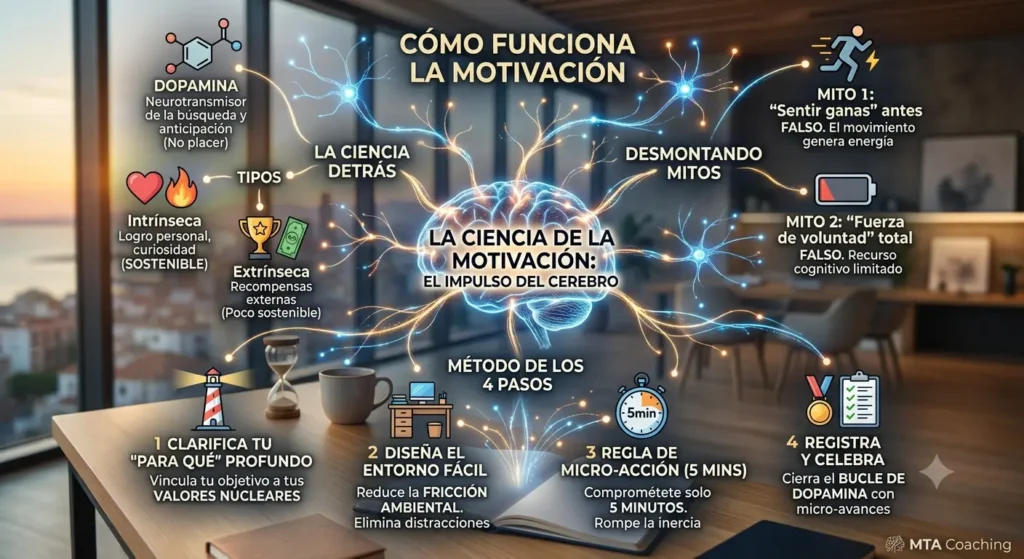
From a scientific standpoint, motivation isn't just a mood; it's a neurobiological process geared toward survival and achievement. The main protagonist here is dopamine,a neurotransmitter (a chemical messenger in the brain) that we mistakenly tend to associate only with pleasure.
Today, we know that dopamine is not primarily released when you achieve a reward, but in anticipation of that reward.It is the chemistry of the pursuit. When your brain detects an opportunity for improvement or a valuable goal, it generates a dopamine spike that drives you to move.
Cognitive psychology divides this drive into two primary types:
- Extrinsic motivation: When you act to achieve an external reward or avoid punishment (a salary, status, or others' approval).
- Intrinsic motivation: When you perform an activity for the pure pleasure, curiosity, or internal challenge of the task itself. Science shows that the latter is the only sustainable form over the long term and what truly drives deep, structural changes in our lives.
Debunking the Biggest Motivation Myths
To manage your energy intelligently, you first need to clear away the false beliefs holding you back:
Myth 1: "Motivation precedes action"
The Reality: This is the most common mistake. We think the linear order is Motivation → Action.In reality, the scientific cycle works backward: Action → Early Success → Dopamine → Motivation.. Movement generates energy; it doesn't wait for it.
Myth 2: "It's all a matter of willpower"
The Reality: Willpower is a finite cognitive resource. If you rely solely on it, you will burn out quickly. Real motivation is cultivated by designing a supportive environment and breaking down goals, not by forcing your mind to its absolute limit every day.
How to Invite Motivation into Your Life: The 4-Step Method
If motivation doesn't arrive on its own, you have to build its path. Instead of waiting for the perfect moment, you can hack your own reward system with this practical sequence:
1.Clarify your deep 'why':
Step 1: Direction.
Ask yourself why this change truly matters. If you're looking to make a career leap, don't stay on the surface ("I want a new job"). Connect with the core value: Are you looking for more autonomy? Do you want to align your talent with something fulfilling? Link your goal directly to your core values.
2.Reduce environmental friction:
Step 2: Environment.
Make starting ridiculously easy. If you want to write, leave the document open on your screen the night before. If you want to plan your week, clear your desk of physical and digital distractions. Your brain hates unnecessary energy expenditure; if the first step requires too much organizational effort, you will procrastinate.
3.Apply the micro-action rule:
Step 3: Trigger.
Commit to working on your goal for just 5 minutes. For example: "I am only going to draft one paragraph of this proposal."By fragmenting the task, you eliminate the subconscious fear of failure. The fascinating part is that once you break the inertia and begin, your brain starts releasing dopamine, and you usually choose to keep going.
4.Track and celebrate micro-progress:
Step 4: Consolidation.
Don't wait until you reach the final finish line to congratulate yourself. The brain needs the positive feedback of success to want to repeat a behavior. Cross the task off your planner or acknowledge the day's effort. That small gesture closes the neurological loop and sets you up for momentum tomorrow.
The Ultimate Push for Your Transition
Understanding the theory is the first step, but putting it into practice when you're in the middle of a major life shift can feel overwhelming. Personal and professional transitions are rarely linear; they come with twists, doubts, and natural plateaus.
If you feel ready to launch your next project but struggle to find focus or maintain momentum, you don't have to navigate it alone. At MTA Coaching, I partner with you to design a tailor-made strategy, combining practical tools and a reflective framework designed to move you from analysis paralysis to conscious action.